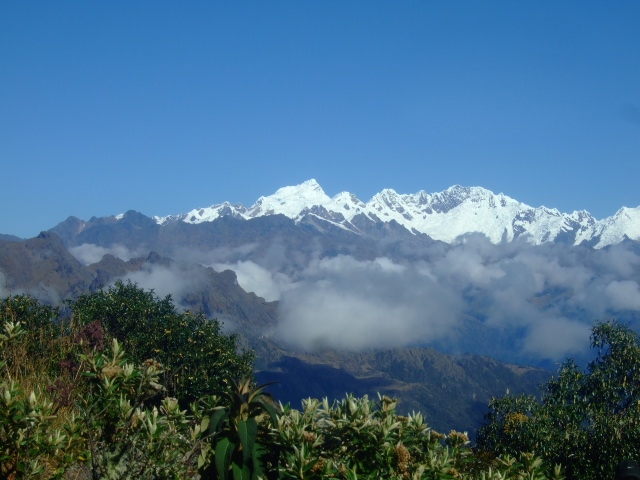
Inca Trail/Machu Picchu, Peru, 2014.
My friend Rich is an adventurer. I like to think of myself as one, too, but I’m not on the level he is. He’s been everywhere: hiking in the Himalayas, scaling Kilimanjaro, trekking through Africa on safari, swimming with dolphins in New Zealand. I’ve got a good travel track record with a couple of difficult National Park hiking trips under my belt. So when Rich asked me if I wanted to go to Peru with him to hike the Inca Trail in celebration of his 60th birthday, I said sure. Sounded fun and adventurous: four days recreating the journey of a lost civilization, camping in the jungle, en route to the infamous “sky city” Machu Picchu. I’ll do some cardio to prepare and we’ll do this!
I started really getting scared the night before the hike. We had been in Cuzco for five days and were acclimated to the altitude, so that was one challenge down. But then, as we were getting a trip orientation at the tour office from a seasoned guide who was brutally honest, I thought, Uh oh. What did I sign up for? The trail was deemed an intermediate hike. Hey, I did the Mist Trail at Yosemite, I thought. It was super-hard, but I did it! Could this be even harder?
The Inca Trail covers 26 miles, broken down into bite-size pieces over the four days. But, the guide warned, it was a challenging up-and-down through alpine tundra, cloud forest, rocky plains and jungle that takes you from 8,500 ft to nearly 14,000 ft in elevation. The second day alone notoriously climbs about 4,000 ft in just under four miles. That particular portion of the path has a name that says it all: Dead Woman’s Pass.
Oh, shit.
The guide assured us that the name didn’t refer to women keeling over and dying on this challenging leg—in particular, little meatball women who stupidly thought a little cardio would help them conquer the Inca Trail. It simply meant that the mountains at the top of the pass resembled a woman lying down. That didn’t make me feel better. Then, he informed us that Dead Woman’s Pass was also the point of no return; if you were going to give up and turn around, you’d have to do it here. Otherwise you’re committed—you’re either crossing the finish line (the Sun Gate) in triumph or you’re being airlifted out by helicopter and a search-and-rescue team.
I said it: “I don’t know if I can do this.” Rich and I made a pact that if one of us turned around, the other would forge on. It was starting to get dramatic. What had I gotten myself into?
When we returned to the hotel, I sent messages to my man friend and my mom, expressing my fears that I was not ready for the Inca Trail. They both wrote back telling me to do my best. “You’ll be fine and you’ll do great!” JJ wrote. Oh, god. My best at this point felt like my best wasn’t even a quarter of what was required to complete this trek.
I also sent a message to a few friends: “We hit the trail tomorrow so I’ll be incommunicado until Monday…please send good vibes in the direction of Peru. I’m getting serious cold feet.”
My friends responded with some encouraging words.
“Just pace yourself—that’s key. You will do fine and you will love it!” said Rebekah.
“You are going to be awesome! Have a great adventure!” said Jeff.
“You got this!” said Tutti.
“I’m rooting for you. Feel me pushing you up that mountain with my intense brain waves of antigravity,” said Karen.
It was helpful, but I was still worried. I went to bed early, and tried to remain positive.
***
We were picked up bright and early (very early) the next morning by our guide Yosep and were greeted by our travel mates, a lovely couple from Mexico who were hiking the trail for their honeymoon. We also picked up a few porters along the way. They would carry our tents, sleeping bags, food and items we didn’t need in our day packs. If these guys can hike the trail carrying 60-pound packs and do all the hard work at the campsite for us, surely I can do this, I thought.
I kept my friends’ words of support in mind when we got to the trail head and prepared to take our first steps. But as I looked around, I noticed everyone was in great shape, wearing expensive, breathable hiking gear made out of things like “Omni-wick” and “comfort stretch.”
I have a recurring dream that I’m forced to go back to school to finish a class that I forgot to take. I have to leave immediately and don’t have books, supplies or a place to stay, which causes me to wake up in a state of panic and anxiety. As we crossed the “sacred river” to start the journey, I felt like maybe this was the real-life version of that dream. I felt completely unprepared.
***
Some steep climbs on Day One fueled my doubts, but a generally flat-ish terrain and the breathtaking scenery kept outright anxiety at bay. It was Day Two—Dead Woman’s Pass day—that I was really worried about. But I decided: mind over matter, positive thinking! I’m going to fight apprehension and do what JJ and Mom told me to: my very best.
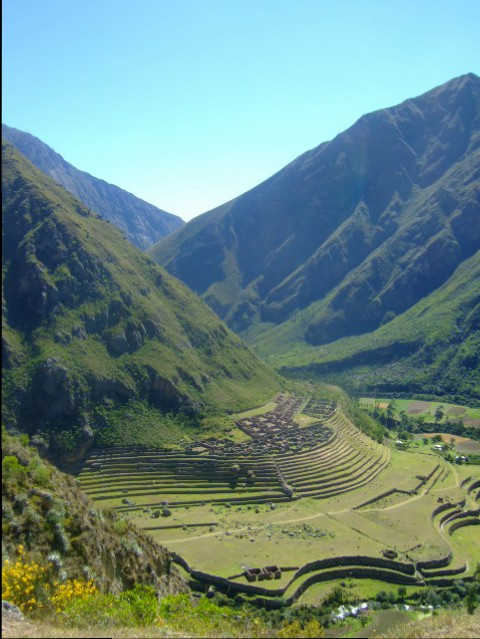
We got started early, hiking through a twisting canopy of trees alongside a crisp, rushing river. Sunlight speared through treetops, highlighting the knotted roots that gripped stones like ancient hands. I paused every once in a while to turn around and see the mountains, perfect green Goliaths with pointed tops severe as upside-down Vs.
The porters zoomed past with fleet feet that seemed almost inhuman. As the trail began to climb, more and more hikers began to pass me and soon I had lost my entire group. My positive thinking was wearing off faster than my SPF 50 sunblock. Then it hit me: I was the weak link. My second-greatest fear, next to falling off the side of the mountain!
For several hours I counted out five steps at a time, stretching to climb steep, uneven stone stairs, and then stopped to catch my breath. Yosep climbed ahead and then waited for me to catch up. “Keep going, Anita,” he said as I trudged closer, panting and sweating like I’d crawled across the Gobi. “Anita, chica fuerte.” I didn’t know what that meant—probably good job or something—and I was afraid of looking like the chubby, out-of-shape American who was arrogant enough to believe this journey would be a piece of cake.
I reached our lunch spot long after the others had already gobbled down their meal and were already sipping coca tea. Everyone applauded as I rounded the corner and Rich greeted me with a hug and said, “I am so proud of you.” I was red-faced, aching and drenched in sweat and doubt. I was staring at the next leg of the journey: Dead Woman’s Pass, a five-hour climb through an alpine tundra to a height of 14,000 ft. The extremely difficult hike of the morning wasn’t even the hard part. “I don’t think I can do this,” I said and asked Yosep for his opinion. Should I turn back? Was I hopeless? “I think you can do it and you should at least try,” he said.
“OK,” I said. “I will try.”
Re-energized from lunch, I developed a plan. I was going to pretend my nephew Noah was at the very top and he needed me. I was also going to picture the smiling faces of JJ and my family and friends and remember what they wrote to me two nights before. I left ahead of everyone else and was soon passed by all, including Rich. Porters raced past me, sandals clacking on the rocks, on their way to our campsite. “Vamos, chica! You can do!” they said, making me smile.
The sky was blue and the sun intensely bright, bathing the dusty taupe mountainside in an almost unnatural spotlight. I peered over the scrub brush down into an olive-green valley, dotted with grazing llamas. Behind me a snow-topped peak pressed into the clouds. It felt like we had to be even with the top of that mountain, even though it was clearly much higher. The altitude was palpable. Soon, I was taking two steps, then stopping to rest. Hikers trekked past, also tired and aching but still confident.
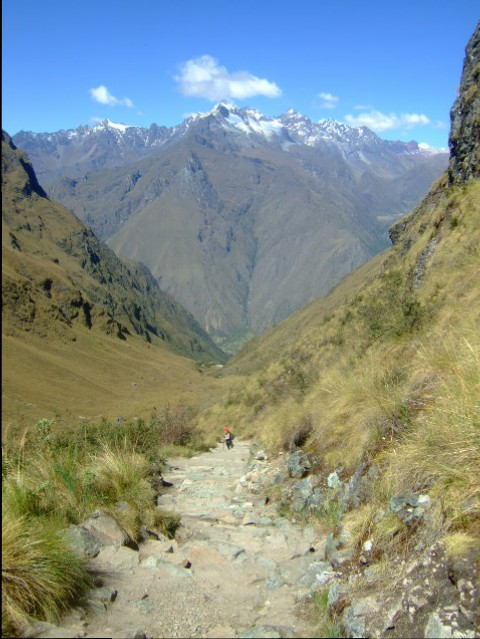
For the first time ever on a trip, I seriously thought about giving up. This was just too hard and I was dumb thinking I was even remotely ready for this. But I was suddenly seized by a thought. I’ve spent too much time in my life hating myself for one reason or another. I’ve beaten myself up so much for everything: I’m stupid. I’m untalented. I’m ugly. I’m a bad friend. I’m weak. I saw JJ smiling at me with his kind eyes and telling me he believed in me. I saw my mom and dad and friends rooting me on with happy cheers. I saw Noah’s bright little face saying, “You can do it, Aunty!” I had to keep trying. I had to go until I collapsed. That would truly be the sign that I was incapable of this journey. I didn’t want to hate myself again.
So I slogged forward. It took hours. It was hot and steep and unrelenting. But eventually I could see the top of the pass. And then I could see Rich and Yosep. They called down to me that I was almost there, just 10 more minutes. I climbed and climbed and climbed and then I reached the top. I looked back at where I’d been and cried. “I can’t believe I did it!”
I really couldn’t. I had come so close to giving up. I was slow. I was out of shape. But somewhere alongside all that doubt and self-hatred, I had a little bit of belief in myself. And I had a smile on my face the rest of the day (which, thankfully, was all downhill—literally).
***
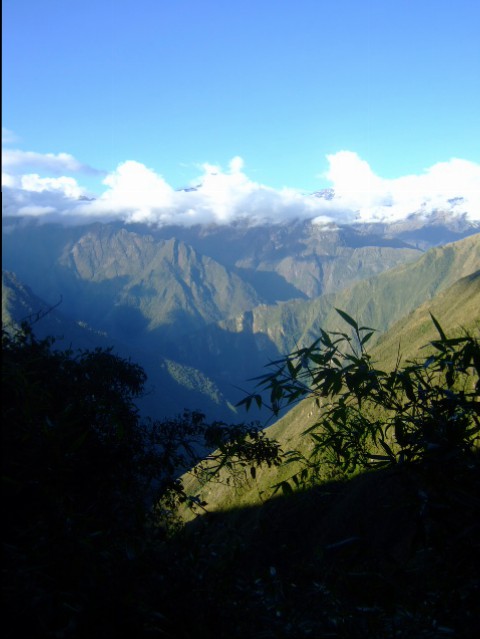
Day 3 was my favorite day. It was the longest day, with some nine hours of up-and-down hiking through a cloud forest. And we really were up with the clouds. The sun was shining again and the path wound through dangling vines and moss in every shade of green and yellow you could imagine. I had “What a Wonderful World” in my head as we wove through the mountains, even passing through a carved rock tunnel built by the Incas themselves. This portion of the trail had steep drop-offs and narrow pathways, but because of the lush greenery, it didn’t feel as treacherous. It was not easy, but because I’d made it through “the hard part,” I knew I could do it.
That night, Yosep held a small ceremony for the porters. Each man introduced himself, told us a little bit about his family and revealed what he had carried for us—sleeping bags, tents, food, cooking supplies, our meal table and more. The youngest porter was 21 and the oldest 53. Most had families and children (some had grandchildren) and had hiked the trail countless times, carrying all the heavy stuff, setting up camp and cooking wonderful meals for the travelers. They do it for extra money; most worked regular jobs as farmers or laborers. Every time a hiker came into the camp, they gathered around and applauded and cheered. It was wonderful and motivating, but I also felt a bit embarrassed because they were the ones doing the real work. They live this “trip of a lifetime” every day, and no tourist can do it without them.
***
On the final day, we got up at 3:30 a.m. and slogged down to line up at a checkpoint, which opened at 5:30. I pulled my hat down and closed my eyes. A group of young hikers next to me were playing cards and had a little boom cube quietly broadcasting music. Two of the songs they played were “Wonderwall” and “That’s Just the Way it Is,” and I’ll always remember those two hours each time I hear them.
When the checkpoint opened, we filed through and began a mad, two-hour dash to the Sun Gate overlooking our final destination: Machu Picchu. I tried to keep up with the crowd, but soon tired and everyone began to pass me again. It was too much too soon and I was deeply embarrassed that I thought I could keep up with their pace.
Once again, Yosep hiked a little bit ahead and then waited for me. Rich and our travel mates were long gone. The trail was slippery and lined with wild orchids in purple, pink and white. One slide and I would tumble down the mountain, I thought. But at least I made it through the hard part. If I died now, at least I would die proud and with a smile on my face.
The two hours seemed eternal. We were almost there and it was like the trail just seemed to stretch out before my eyes. We reached a set of stairs that went straight up. Yosep took my backpack and I scrambled up with my hands and feet. Challenges were just challenges now, not impossibilities, and I just wanted to ring the bell at the top of Jacob’s Ladder.
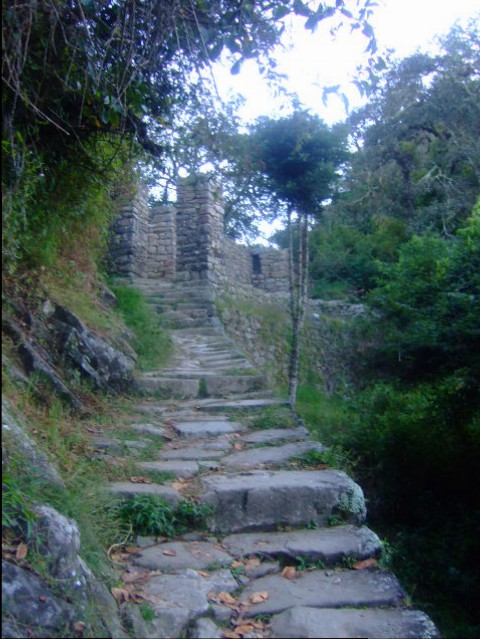
Then, Yosep pointed to a rocky outcropping in the near distance. “See that?” he said. “That’s the Sun Gate.” Tears immediately stung my eyes and before I knew it, I was gasping with sobs. Before me was a small incline and Rich’s grinning face peering around the corner. I reached the top and began crying uncontrollably. I hiked the Inca Trail!
I feel like I got a few weird looks and Rich threatened to take a photo of me in hysterics. But I didn’t care.
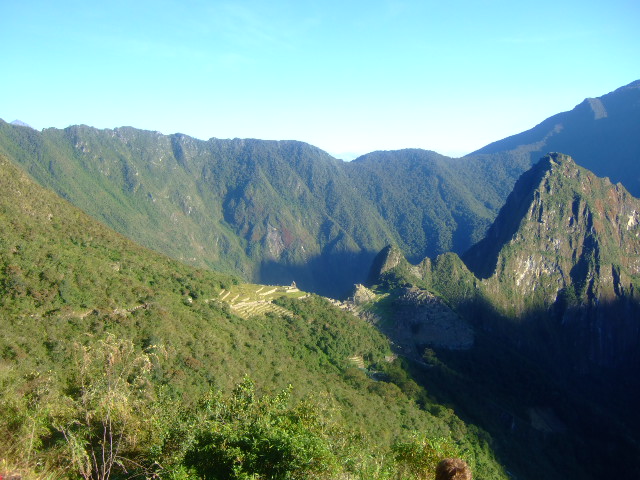
Yosep took my arm and said, “Here, Anita, let me show you.” He led me around the corner and there it was: Machu Picchu. The lost city in the sky. The sun was rising over the ruins. Even now I can remember every detail.
***
Lots of crazy things go through your head during an extreme physical challenge. I’m sure marathon runners and triathletes and Olympians can tell you the same. This was true for me. I thought a lot about life and loved ones and how I viewed myself. There are so many beautiful things in the world—and in life. I’m incredibly lucky to have such wonderful people around me and the health and ability to see what the world has to offer.
But one of the biggest things I took away was that physical toughness is relative. Stronger, fitter people than I could do this much faster and with more ease. That’s OK. I’m slow and out of shape–but I still did it. The old cliche is true: mental toughness is far more important when it comes to completing a physical task. I started this trip feeling out of my element. But at the end, I was there with everyone else watching the sun rise.
I also found out that chica fuerte means “strong lady.” Could that really be me? Yes. Even though I second-guess myself or go through periods of oppressive sadness, I can still be chica fuerte. It may sound silly, but it’s true: it’s just all part of the hike and the adventure.
***
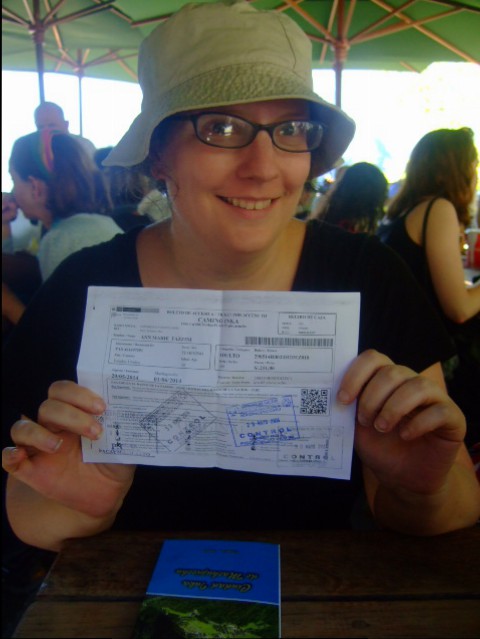
When we got back to the hotel, I took a long, hot shower and then sent a message to JJ, Mom & Dad and my friends: “Guess what…I DID IT!” I included a picture of myself smiling proudly at Machu Picchu. I remember how I felt in this photo: like I could truly do anything. I could not stop smiling. And I could not wait to share my trip tales with the people I love.
There she is: chica fuerte, unstoppable and on top of the world. A true adventurer.

 C-bus Rock City