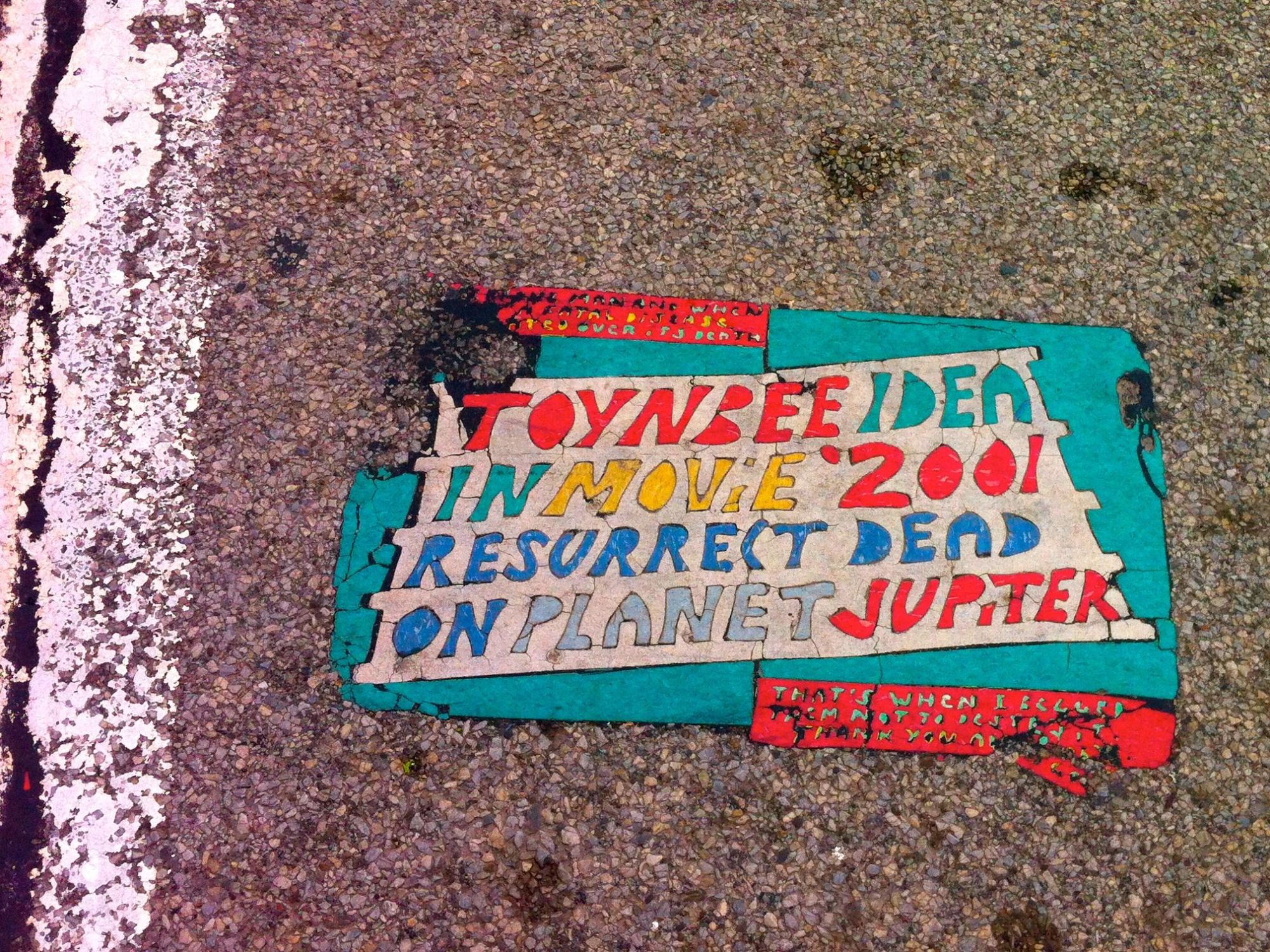
Cleveland, Ohio, 2014.
I wrote this article for Country Living magazine.
TOYNBEE IDEA
IN KUBRICK’S 2001
RESURRECT DEAD
ON PLANET JUPITER
A variation of that cryptic message, carved on colorful, folk-artsy tiles, started popping up around Philadelphia in the mid-1980s. Soon, more mysterious tiles appeared in other cities, like New York, Pittsburgh and Baltimore.
Even more mysterious is where they were popping up — embedded in asphalt in bustling crosswalks and streets at major intersections in about two dozen cities in the U.S. — including Cleveland, Columbus, Toledo and Cincinnati — and even as far away as Rio de Janeiro, Brazil, and Santiago, Chile.
What does the message mean? Who placed the tiles? How were they made? And how did the artist get them in the middle of major thoroughfares without ever being seen?
Guerrilla propaganda, art, vandalism, social commentary — whatever you call it, the bright linoleum plaques have commanded attention for decades and have left the thousands who have stepped on one as they cross a street wondering what it all means.
A recent documentary aimed to solve the intriguing riddle. Resurrect Dead: The Mystery of the Toynbee Tiles follows three friends as they track down tiles, research their messages and attempt to discover who was behind them.
The captivating movie inspired me to do some more research and find out what became of the nine tiles in the Buckeye State.
But first, what does that message mean? The Resurrect Dead filmmakers are still unsure, but “Toynbee” is most likely Arnold J. Toynbee, a British historian who studied the rise and fall of historic civilizations. “Kubrick’s 2001” almost certainly refers to the movie 2001: A Space Odyssey, directed by Stanley Kubrick in 1968, which follows outer space explorers as they travel to Jupiter.
“Resurrect Dead on Planet Jupiter” may be a reference to the movie or an article that appeared in a 1983 edition of the Philadelphia Inquirer that outlined a concept of bringing Earth’s deceased back to life on that planet.
There are many theories floating around on what each line means and how they connect, but no one is certain.
As more people discovered tiles in their cities, an Internet community was born to catalog sightings and discuss theories.
In 2001, Cincinnati’s CityBeat magazine conducted an investigative report on three tiles that appeared in the Queen City’s downtown area, but it raised more questions than answers. “I have no idea what they are,” said downtown street inspector Dennis Maddock. “I have no idea what they mean,” said Sgt. David Turner of the Cincinnati Police force. “We have no idea who put them there,” said another city official.
To help make sense of the puzzle, writer John Stoehr tracked down Toynbee tile aficionado Bill O’Neill, who ran a website that listed tiles and their locations. Over the years, O’Neill received many photos of plaques from readers — and tantalizing tips about who the mystery artist may be. But despite follow-ups, dead ends and a few close calls, he never discovered the tiler’s true identity.
Sadly, Cincinnati’s three tiles no longer exist. They were paved over or dug up during street repair or otherwise worn away by time. Columbus had one, too, right at the intersection of Broad and Third streets in the shadow of the Ohio Statehouse. That one was also destroyed by road construction. And Toledo’s three tiles were lost to repaving.
But as of January 2014, one of Cleveland’s two original tiles is still in place in the middle of a crosswalk at the West Prospect and 3rd St. intersection. Its edges are chipped, but the rainbow-colored tile is still in good shape.
It’s also located in a high-traffic area by Tower City mall, which raises the perplexing question of how the creator embedded it in the street without anyone seeing. One was even found inside New York’s Lincoln Tunnel, and how on earth did anyone place it there in a city as bustling as New York and in a tunnel with so much traffic?
One popular theory is that the artist somehow cut a hole in the passenger-side floor of his or her car and covertly pushed the pre-made tiles out while stopped at an intersection. The tiles, which are bonded with an asphalt-like filler, are permanently pressed into the street by the weight of passing cars.
The Resurrect Dead filmmakers believe they know who is laying the tiles — a reclusive genius in Philadelphia who also just happens to have a car with a hole in the floor. But all attempts to contact the man have gone unanswered.
“For years I wanted to solve the mystery,” said researcher Justin Duerr in Resurrect Dead. “I have to learn when to let go.”
Tiles continue to turn up around the country, many believed to be copycats of the original Toynbee plaques. So the artist’s message is still spreading — and its mystery continues to both baffle and inspire those who cross a tile’s path.
 C-bus Rock City