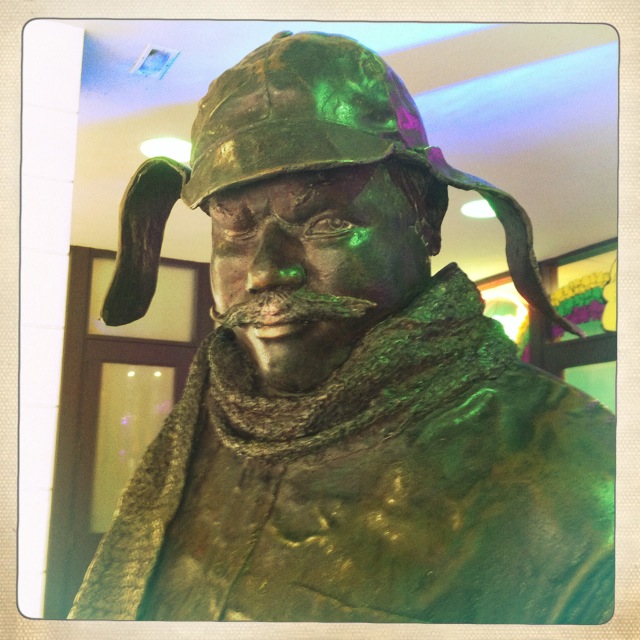
New Orleans, La., 2013.
A green hunting cap squeezed the top of the fleshy balloon of a head. The green earflaps, full of large ears and uncut hair and the fine bristles that grew in the ears themselves, stuck out on either side like turn signals indicating two directions at once. Full, pursed lips protruded beneath the bushy black mustache and, at their corners, sank into little folds filled with disapproval and potato chip crumbs.
That’s how we first meet Ignatius J. Reilly, the protagonist and anti-hero star of the Pulitzer Prize-winning tome A Confederacy of Dunces. You may love him as an eccentric, anti-establishment curmudgeon, you may hate him as a boorish snob who ruins the fun of others and treats his mom like shit. Either way, you will never forget him.
In the shadow under the green visor of the cap Ignatius J. Reilly’s supercilious blue and yellow eyes looked down upon the other people waiting under the clock at the D. H. Holmes department store, studying the crowd of people for signs of bad taste in dress. Several of the outfits, Ignatius noticed, were new enough and expensive enough to be properly considered offenses against taste and decency. Possession of anything new or expensive only reflected a person’s lack of theology and geometry; it could even cast doubts upon one’s soul.
My love affair with Confederacy was ignited by my friend Rich and we both count it among our favorite books ever (and if you haven’t read it, DO IT). So of course, during a four-day jaunt to the Big Sleazy, we scheduled in some time to hunt down some Ignatius-related haunts.
First stop: under the clock at the D.H. Holmes department store! It’s now a Hilton hotel, but the iconic shopping center referenced in the book stood here for a whopping 140 years before closing in 1989. There’s now a bronze representation of Ignatius standing outside, waiting for his mother (and minutes before he throws a wild temper tantrum during which he refers to a cop as a “blue meanie”). He’s wearing his hunting cap, earflaps askew, and holding a bag that contains a string for his lute. It would be a good depiction of our anti-hero, except for one thing: he’s way too skinny!
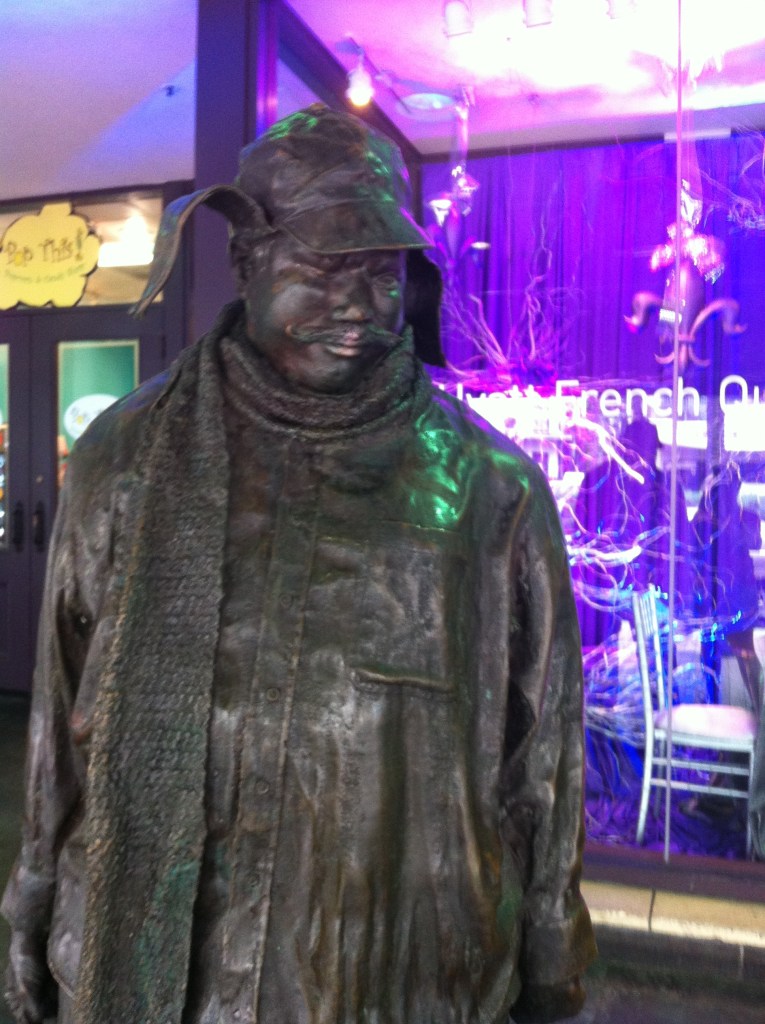
We, of course, posed with Ignatius, leaning on him like we were old pals (something that probably would have sent real-life Ignatius into a PhD-level verbal frenzy). The photo ops were fun, but we needed to see more. So we ventured into the French Quarter and quickly spotted another Ignatius-related artifact.
Paradise Vendors, Incorporated, was housed in what had formerly been an automobile repair shop, the dark ground floor of an otherwise unoccupied commercial building on Poydras Street. The garage doors were usually open, giving the passerby an acrid nostrilful of boiling hot dogs… The powerful stench of Paradise Vendors, Incorporated, sometimes led the overwhelmed and perplexed stroller to glance through the open door into the darkness of the garage. There his eye fell upon a fleet of large tin hot dogs mounted on bicycle tires.
[NOTE: I took a photo of the wiener-shaped hot dog cart, but I can’t find it! I will post it when I dig it up, but you can see a really fun one here in the meantime.]
Ignatius, of course, lasted less than a day as a hot dog vendor when he ate his entire stock. Rich decided he had to try one, slathered it with mustard and, upon finishing, declared it “not great.” Oh, well. But, hey, another stop on the Dunces tour down.
Next destination: the Garden District.
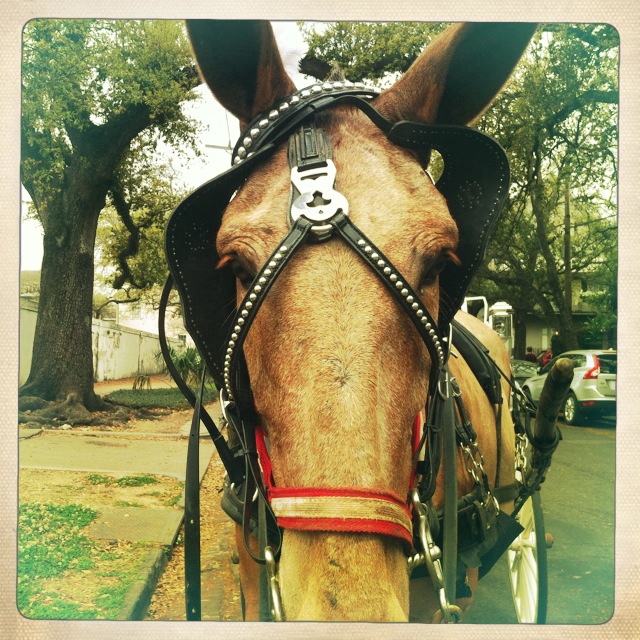
After our tour of fancy houses (during which we actually saw the John Goodman on the porch of his own home petting a dog), Rich suggested we might be close to Ignatius’ home base:
At Constantinople Street he turned toward the river, sputtering and growling through a declining neighborhood until he reached a block of houses built in the 1880s and 90s, wooden Gothic and Gilded Age relics that dripped carving and scrollwork. … It was a neighborhood that had degenerated from Victorian to nothing in particular, a block that had moved into the twentieth century carelessly and uncaringly—and with very limited funds.
We decided to walk to Constantinople Street and find the house. So we walked. And walked. And walked. And walked. And it was much farther away than it looked on the map. And it started to sprinkle rain.
Finally, we found the street. But the house was another story.
The address that Patrolman Mancuso was looking for was the tiniest structure on the block. … A frozen banana tree, brown and stricken, languished against the front of the porch, the tree preparing to collapse as the iron fence had done long ago. Near the dead tree there was a slight mound of earth and a leaning Celtic cross cut from plywood. The 1946 Plymouth was parked in the front yard, its bumper pressed against the porch, its taillights blocking the brick sidewalk.
As much as I wanted to find this scene exactly, and several yards on the quiet, industrial street featured rusting relics and husks of some kind, we concluded that the Reilly house was certainly based upon these homes, but not any particular one.
So concluded our quest to find Ignatius (or at least Ignatius-related landmarks) and we took the bus back to Canal Street, where drunken revelers screeched like banshees, sported giant plastic breads and double-fisted icy alcohol bombs in cups shaped like vuvuzelas.
I could only imagine what Ignatius would say.
When a true genius appears in the world, you may know him by this sign, that the dunces are all in confederacy against him.
P.S. If you liked Confederacy, be sure to check out the biography of the man behind it: Ignatius Rising: The Life of John Kennedy Toole. He’s a fascinating guy. The gist of his sad story is that he peddled his manuscript to a slew of publishing houses, only to receive one rejection after another. That, coupled with severe depression, debilitating headaches, an escalating drinking problem and declining mental health, led Toole to take his own life at age 31. Years later, his grieving mother continued to send his manuscript out to publishers, determined to give her son—and his talent—a lasting legacy. Eventually, the University of Louisiana Press picked the book up for a 2,500 copy run. A year later, A Confederacy of Dunces was awarded the Pulitzer Prize for Fiction.
 C-bus Rock City